Important documents checklist for aging parents
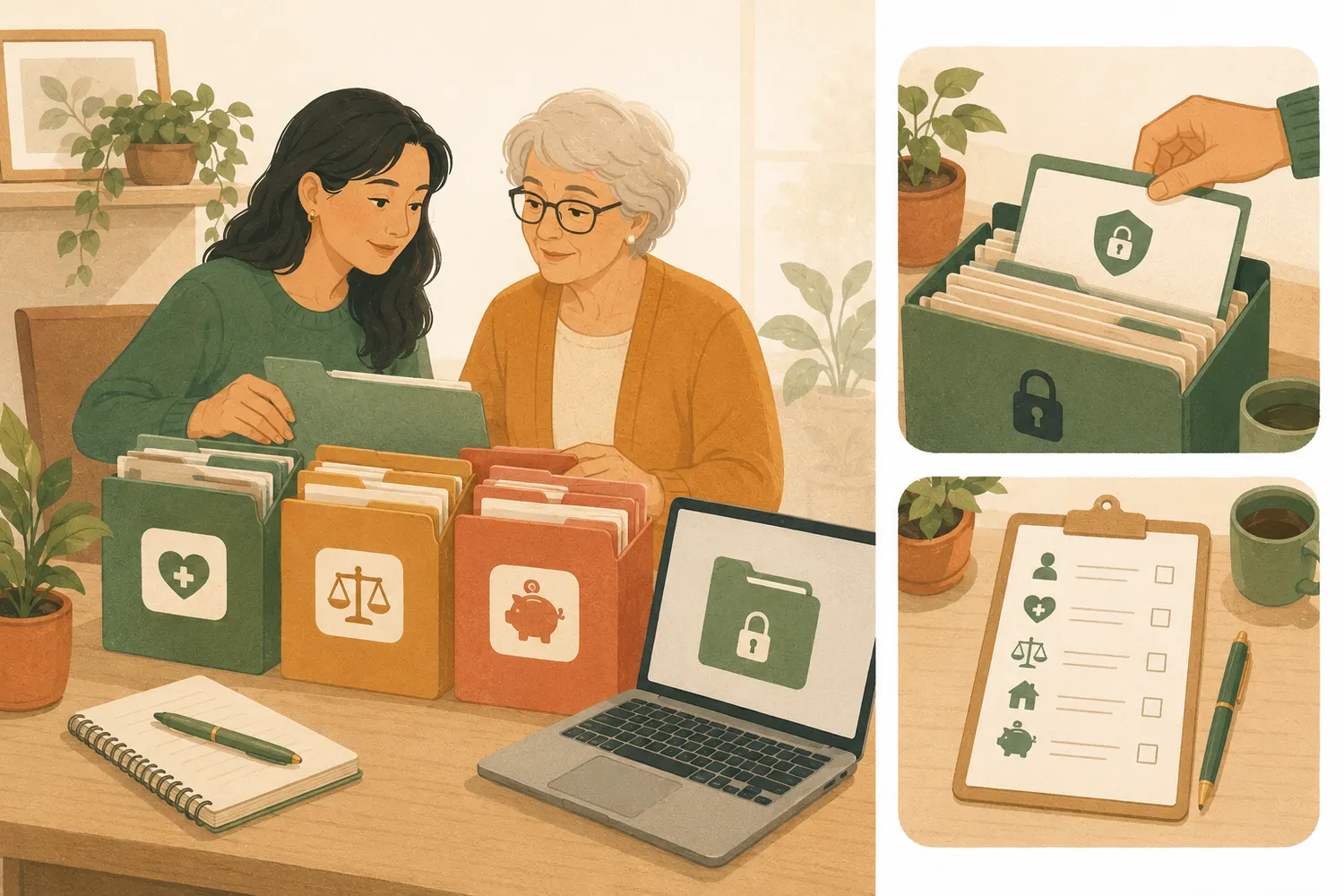
When something happens, the scramble for documents is its own crisis: which insurer, which login, where's the power of attorney, who's the doctor? Getting this organized before you need it is one of the highest-leverage things a family can do - and one of the calmest, because you can do it on a quiet afternoon instead of in an emergency.
Here's the parents' documents checklist to gather first, plus a privacy-first way to keep it useful without turning the family care record into a risky pile of copies.
What to gather
Start with an index, not a box. For each item, record where it lives, who owns access, how to request it, and when someone last checked that it is current.
Medical and care
- Current medication and allergy list
- Doctors and specialists with contact details
- Insurance / Medicare details and cards
- Advance directive / living will, and healthcare proxy
- Pharmacy, preferred hospital, durable medical equipment supplier
- Recent discharge instructions, therapy notes, or home-care instructions
Legal & financial
- Will and any trust documents
- Power of attorney (financial and medical)
- Bank and investment accounts
- Mortgage / lease, deeds, and major bills
- Pension, Social Security, annuity, and retirement-plan contacts
- Tax preparer, attorney, insurance agent, and financial advisor
Household and emergency
- Home insurance, auto insurance, property tax, HOA, lease, or deed location
- Utility providers and account owner names
- Alarm codes, spare-key location, gate codes, and building access notes
- Important contacts: neighbors, lawyer, accountant, clergy
- Pet care, regular service providers, and trusted local helpers
Everyday and digital access
- Key account locations: utilities, pharmacy portal, email, banking, phone, internet
- Home info - alarm codes, where spare keys are, who the handyman is
- Password manager location and emergency-access process
- Phone passcode or device-recovery plan, if your parent wants the family to have it
- Instructions for paper mail, online bills, and autopay
10-minute setup: make the index useful
Create one shared document or care-space note with six columns:
| Item | Where it lives | Who can access it | Owner | Last checked | Emergency note |
|---|---|---|---|---|---|
| Medication list | Pharmacy portal and printed fridge copy | Family coordinators | Dana | July 2026 | Bring to urgent care |
| Advance directive | Attorney file and locked home folder | Healthcare proxy only | Priya | July 2026 | Do not upload copy to group chat |
| Utility accounts | Provider sites | Local sibling | Mateo | July 2026 | Needed if parent is hospitalized |
The goal is not to finish every document in one afternoon. The goal is to stop the guessing. Even a partial index helps if everyone can see the owner, source, and next missing item.
The privacy-first principle: link, don't hoard
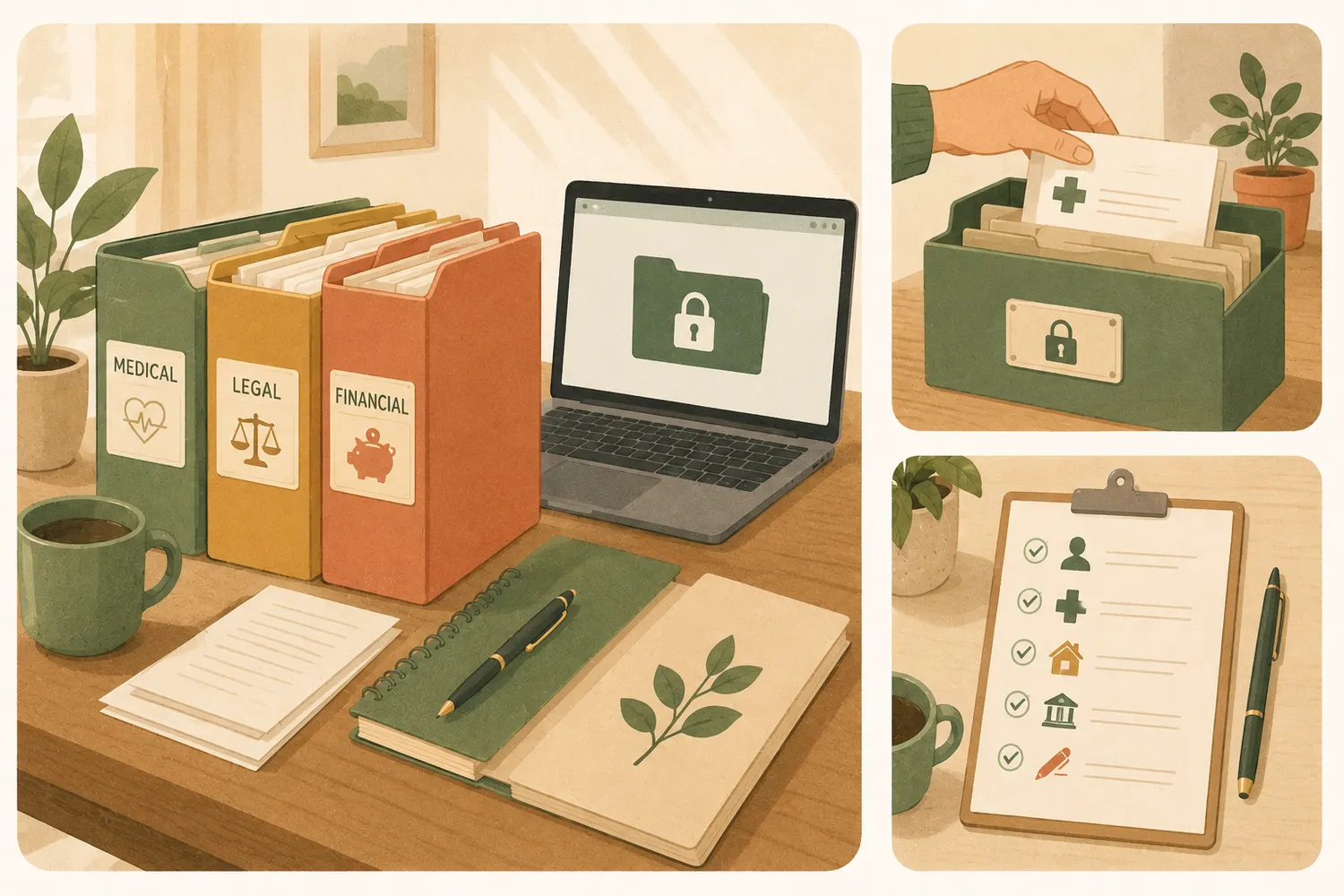
It's tempting to photograph everything into one folder. Resist it. A pile of copies goes stale the moment the original changes, and it concentrates sensitive data in one risky place.
Better: keep each document where it already lives - the secure portal, the lawyer's file, the shared drive - and keep just a labeled link to it. The source stays the source of truth, with its own permissions, and your care record stays a tidy index instead of a document graveyard. (This is exactly how Foveia handles documents - see security & privacy.)
For the genuinely sensitive items - passwords, account numbers - use a proper password manager or a sealed document with your attorney, not a shared note. Link to where it's kept and who holds access, not the secret itself.
Decide who can see what

Not everyone in a care circle needs the legal and financial layer. A helper logging visits shouldn't see the will. Agree on access up front: who holds the originals, who can view links, and who's simply contributing day-to-day. Clear roles are what make it safe to get organized together. (More in how to coordinate care for aging parents.)
Use three access levels:
- Daily helpers: visit notes, medication reminders, appointment logistics, household contacts.
- Family coordinators: the document index, providers, insurance contacts, task owners, and emergency instructions.
- Decision-makers: legal documents, financial authority, account access, and end-of-life instructions.
That separation matters. It lets the family accept help without giving every helper access to everything.
Keep it current
Documents drift - a new doctor, a changed policy, a closed account. Put a recurring reminder on whoever owns the index:
- Review once a year.
- Review after a hospital stay or major diagnosis.
- Review after a move, new aide, new doctor, new insurance plan, or changed family role.
- Mark the last-checked date even when nothing changed.
Foveia gives your family a shared, role-scoped place to keep these links organized - so the document you need is one tap away, and the sensitive ones stay exactly as private as they should be.
Free: the important-documents inventory
A printable inventory of the documents every family should be able to find — insurance, will, portals, logins — with where each one lives.
Keep reading
What to write down after visiting an aging parent
A practical post-visit note template for adult children: what changed, what looked normal, what needs follow-up, and who owns the next step.
Power of attorney and decision authority for aging parents: a coordination guide
A plain-language coordination guide to power of attorney, healthcare proxies, advance directives, and who can make decisions for an aging parent.
Elderly parent check-in checklist
Use this elderly parent check-in checklist template for phone and in-person visits, with repeatable questions, follow-ups, and clear ownership.