Care Coordination for Aging Parents: What the Research Shows
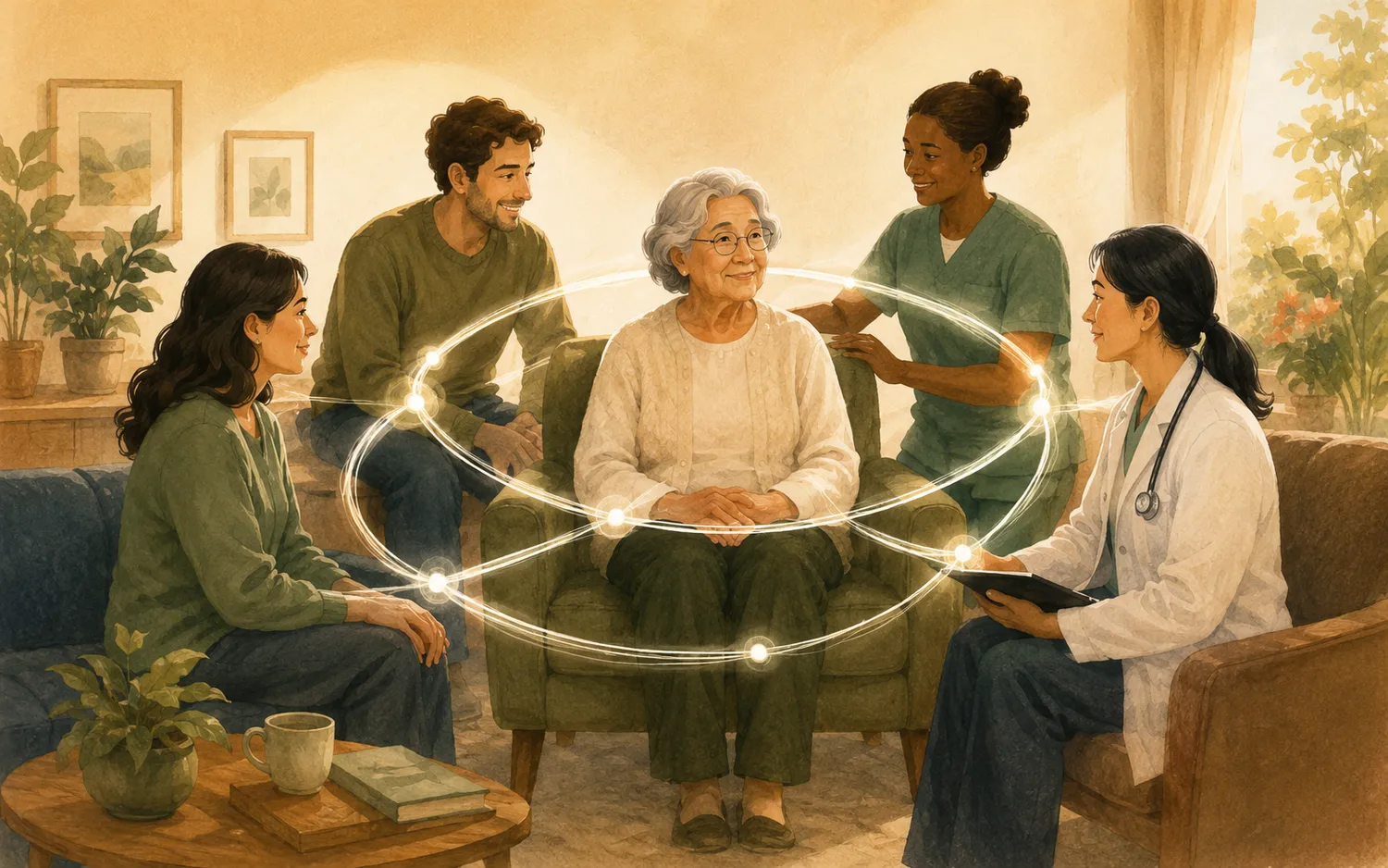
For most families, caregiving begins as a list of errands. Pick up the prescription. Drive Dad to cardiology. Text your sister about the new medication. Remind Mom to drink water. Ask the home aide how the afternoon went. Call the doctor, because no one is sure whether the swelling is new.
At first this feels like family admin. Over time it becomes something harder to name and harder to manage: a coordination system. And that shift matters, because in health care research, coordination is not a synonym for being organized. The Agency for Healthcare Research and Quality (AHRQ) defines care coordination as the deliberate organization of a patient's care activities, and the sharing of information among everyone involved, in order to make care safer and more effective. For a family looking after an aging parent, that is not an abstraction. It is the daily work of making sure the right person knows the right thing at the right time.
The trouble is that almost no family is handed a system for this. They build one by accident, out of group texts, voicemails, sticky notes, portal messages, screenshots, and whatever one sibling remembers from the last appointment. Often the improvised version holds — until the situation gets more complicated. A hospital discharge. A medication change. A new diagnosis. A fall. A rehab stay. A parent who can no longer narrate their own care. At that point the gaps in the system start to show, and a growing body of research suggests those gaps are not just inconvenient. They are bound up with safety, quality of care, and how heavily the work falls on the people doing it.
Caregiving becomes coordination before anyone calls it that
The scale of this work is larger than most people assume. In 2025, AARP and the National Alliance for Caregiving estimated that roughly 63 million Americans — nearly a quarter of all adults — were caring for a family member. Most were helping another adult, often with the full range of daily life: meals, housework, transportation, appointments, finances, and medications.
And much of it is not the gentle, emotional-support version of caregiving people picture. Families increasingly do work that looks close to clinical execution — managing medications, tracking symptoms, dressing wounds, supporting mobility, preparing for appointments, and following up after a hospital or emergency visit. Yet the same 2025 report found that only 22% of caregivers had received any training for these tasks.
This is where the load quietly compounds. The family is no longer just helping. The family has become the place where the care plan is stored — in memory, across several people, none of whom necessarily holds the whole picture. Who changed the medication, and why? What did the specialist actually say? Which symptoms mean "call the doctor" and which mean "wait and see"? Who has the current list? When those answers live in fragments, every new development forces the family to reassemble the plan from pieces.
The three circles of care
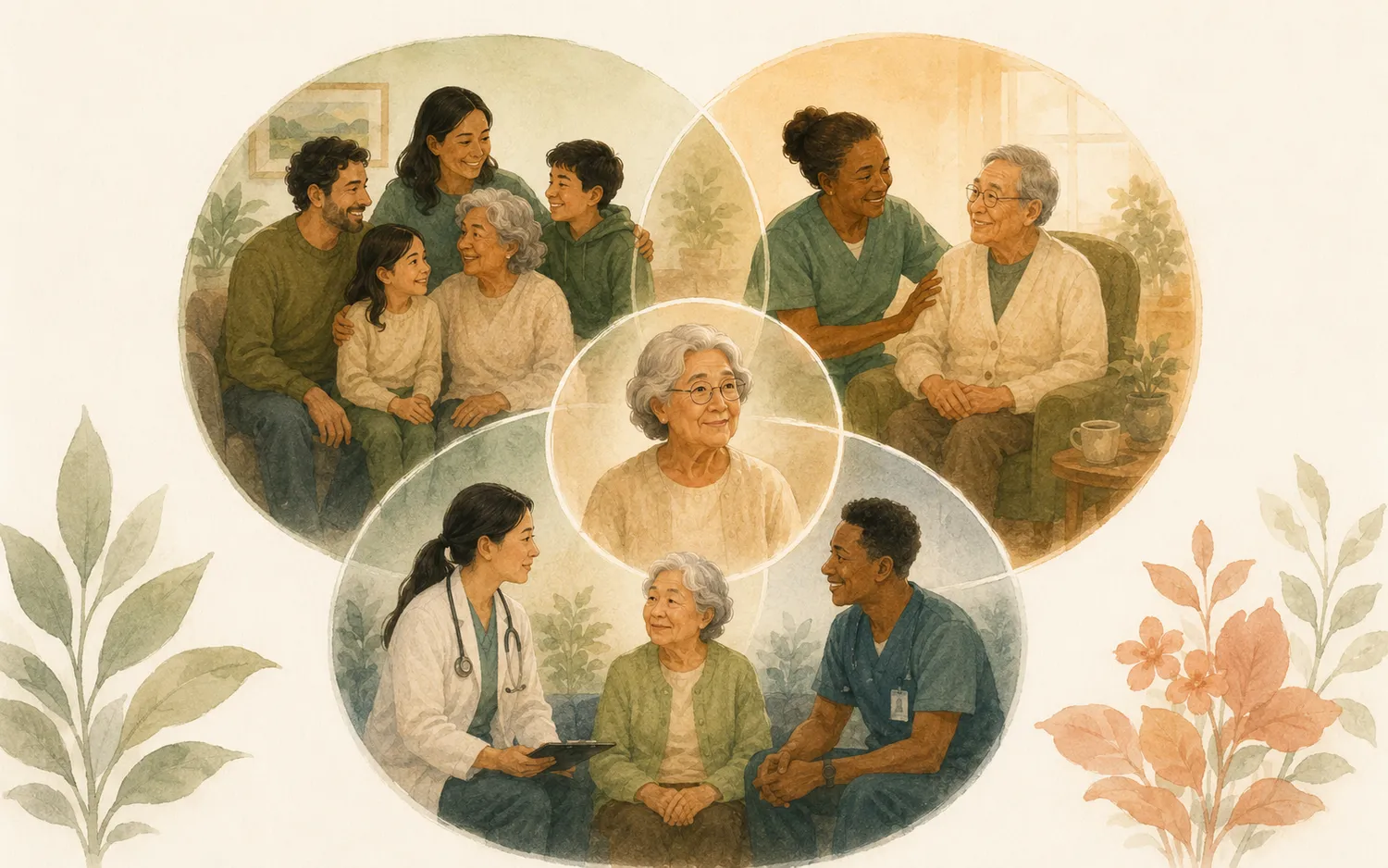
It helps to picture aging-parent care as three overlapping circles.
The first is the family circle — siblings, spouses, adult children, other relatives, close friends, neighbors. These are usually the people who carry continuity. They know the parent's routines, fears, and preferences, and they notice the subtle changes that don't show up in a fifteen-minute appointment.
The second is paid help — home aides, companions, assisted-living staff, drivers, meal and cleaning support. These people often see what the family misses, especially during the workday or overnight.
The third is the medical circle — primary care, specialists, nurses, therapists, pharmacists, social workers, discharge planners, and the staff who keep a health system running.
A 2025 study in JAMA Network Open gives this picture unusually firm footing. Looking at 2,811 family and unpaid caregivers of community-living older adults with disabilities, the researchers found that 87.6% were coordinating with at least one other group — medical professionals most often, then other family caregivers, then paid caregivers. The solo caregiver, in other words, is the exception, not the rule.
The more striking finding is that coordination quality was not the same across the three circles. Caregivers reported their strongest coordination with other family members, weaker coordination with paid helpers, and their weakest coordination of all with medical professionals. That ordering makes intuitive sense: families talk constantly, aides are often physically present, but clinicians operate inside appointment slots, portals, privacy rules, billing codes, and fragmented records. The circle that matters most clinically can be the hardest one for a family to actually coordinate with.
What "good coordination" actually means
The JAMA study is useful partly because it refuses to treat coordination as a vague feeling. It borrows a framework called relational coordination, developed to study work that is interdependent, uncertain, and time-sensitive — a fair description of caring for a declining parent. In the version adapted for caregivers, good coordination has a few concrete ingredients: frequent communication, problem-solving (rather than blame-shifting) communication, shared goals, shared knowledge, and mutual respect. The broader framework adds that the communication should also be timely and accurate.
Stated plainly, that is exactly what families are reaching for when they say they just want everyone "on the same page." Shared goals mean agreement on what the care is meant to protect — safety, independence, comfort, sleep, nutrition, fewer falls, more time at home. Shared knowledge means the right people know the diagnoses, the medications, the warning signs, the appointments, and what has changed lately. Mutual respect means recognizing that the family, the aide, and the clinician each hold a different piece of the truth, and none holds all of it. Problem-solving communication means updates that help the group decide what to do next, not just report what happened. And timely, accurate communication means capturing the important change before it dissolves into someone's memory.
Why the group text breaks down
Group texts earn their place because they are instant. They are also fragile. They blend the urgent with the trivial, bury the details that matter, and make it genuinely hard to find the current medication list, the last visit summary, or the decision everyone supposedly agreed to last week. They also distribute the work unevenly: one sibling becomes the de facto coordinator, another drifts out of the loop, and a third surfaces only once something has already gone wrong.
A thread is good at answering a single narrow question — "Can anyone take Mom on Thursday?" It is bad at being a durable record of a person's care. And a durable record is increasingly what families are expected to maintain, because the health system hands them the plan and then steps back. The National Academies of Sciences, Engineering, and Medicine put the contradiction bluntly: the U.S. health care and long-term care systems lean heavily on family caregivers to coordinate services, manage transitions, and carry information between providers — while frequently failing to identify, train, or support those same caregivers, and often without giving them information that is timely, understandable, and complete. The family, in effect, becomes the connective tissue between systems that were never built to connect on their own.
The clinician gap

The weakest link, again, is the medical circle. In the 2025 JAMA study, caregivers' relational coordination scores were lowest with medical professionals — even though clinicians were the group they dealt with most.
This is not a story about uncaring doctors. An earlier JAMA Network Open study, from 2020, found that caregivers who did interact with health care workers usually felt listened to, and were generally asked whether they understood the treatment. But two numbers from that same study reframe the issue. First, 56.3% of caregivers had had no contact at all with their care recipient's health care workers in the past year. Second, among those who did, only 28.2% were usually or always asked whether they themselves needed help managing the care. A caregiver can understand the treatment perfectly and still be left alone to run it.
The encouraging part is that the 2025 study points to what actually moves the needle. Coordination with clinicians was stronger when caregivers had received role-related training, when they interacted with clinicians more often, and when someone thought to ask them what help they needed. Good coordination, then, is not purely a test of how hard the family tries. It also depends on whether the system treats the caregiver as part of the care team in the first place.
Discharge is where the cracks become visible
If there is a single moment that exposes a family's coordination, it is hospital discharge — the point where responsibility shifts, fast, from professionals back to the patient and the people around them.
AHRQ's IDEAL discharge planning approach treats patients and families as genuine partners in that handoff, and it organizes the conversation around five things: what daily life at home will actually look like, what changed about the medications, which warning signs and problems to watch for, what the test results mean, and what follow-up has been scheduled. Those five areas map almost perfectly onto where family coordination fails when information is scattered — who understands the new schedule, who knows which symptoms warrant a call, who booked the follow-up, who has the results, and whether anyone has told the paid aide what changed.
There is reason to take this seriously rather than treat it as paperwork. A meta-analysis of randomized trials found that bringing caregivers into discharge planning was associated with a 25% lower risk of readmission at 90 days and a 24% lower risk at 180 days. That is not a claim that any particular tool or checklist prevents readmissions on its own. It is evidence that involving the caregiver at a transition is not a courtesy — at the moments that matter most, it can be part of safer care.
Training helps. Systems are still missing.
Caregiver training is, encouragingly, starting to be recognized in policy and payment. Medicare Part B now covers caregiver training services in certain circumstances, when a clinician decides it's an appropriate part of the patient's treatment plan — and the covered areas are concrete: giving medications, helping with daily tasks, moving someone safely, communicating, managing a condition, providing emotional support, and preventing complications like pressure sores, infections, and wounds.
That is real progress. But training and coordination are different problems. A caregiver can be taught exactly how to change a dressing and still lose track of who knows what, who did what, and what changed since Tuesday. Knowing how to do the task is not the same as keeping a household full of people aligned on it over months.
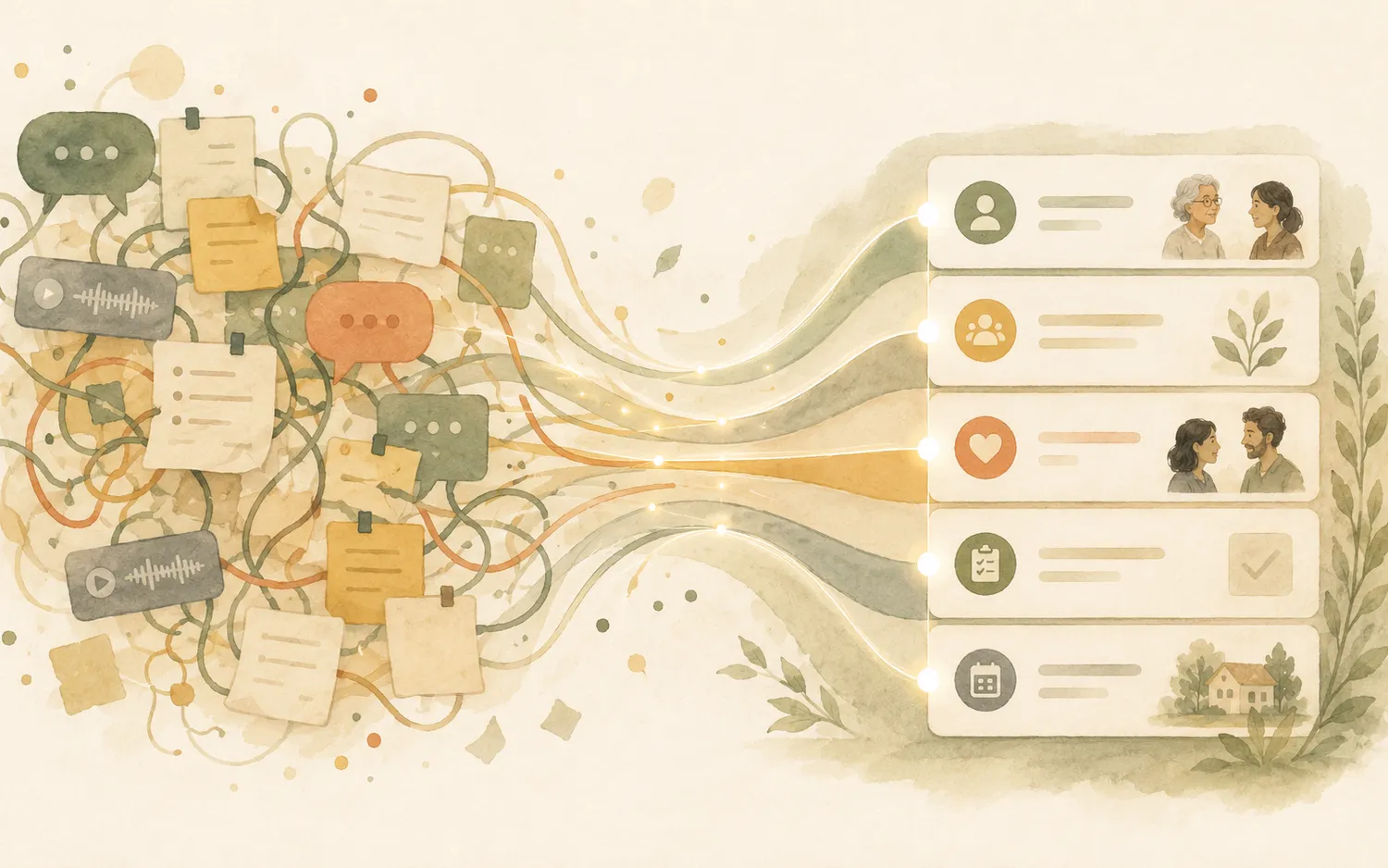
What families are missing is a way to turn scattered care information into shared, operational knowledge — something more durable than a thread and more current than memory. In practice that means a single up-to-date medication list, a clear roster of the care team, a short summary after each appointment, defined tasks and roles, notes from the paid helpers, an agreed list of warning signs, a running set of open questions for the next clinician, timestamped updates, a record of what was decided, and handoffs that don't depend on any one person remembering.
What a family can do this week
None of this requires waiting for a crisis. A few moves can cut the confusion almost immediately.
- Build one care roster. List everyone with a role — family, aides, clinicians, pharmacy, therapists, emergency contacts — and note what each person is responsible for, not just how to reach them.
- Assign ownership by area. Let one person own appointments, another medications, another insurance, another meals and transportation, another home safety. Without that clarity, coordination defaults to whoever is most anxious or most available — which is how one person ends up carrying everything.
- Write a short note after every visit. Date it, and capture who was there, what changed, any medication updates, the warning signs to watch, the next steps, and the questions that went unanswered.
- Hold a brief weekly check-in. The agenda can be three questions: what changed, what's stuck, and what has to happen next week.
- Prepare for any discharge or major transition using the five IDEAL areas — home life, medications, warning signs, test results, and follow-up.
- Ask clinicians the caregiver questions directly. "What do we need to know to make this plan work?" "What should trigger a call?" "Who do we reach after hours?" "Can you show us how to do this safely?" "Would caregiver training be appropriate here?" The research is fairly consistent that coordination improves precisely when caregivers get training, regular contact, and that kind of supportive exchange.
The real takeaway
Care coordination for aging parents gets treated as invisible labor — the stuff that just happens, somehow, in the background of a family. The research makes a stronger case than that. This is the work that holds continuity together across systems that don't talk to each other. It's how a medication change on a discharge sheet becomes an actual routine at home. It's how a warning sign gets caught early instead of late. It's how a paid aide finds out what happened at yesterday's appointment, how siblings stop relying on one exhausted person's memory, and how a clinician finally gets a clear view of what life looks like between visits.
The evidence doesn't support miracle claims, and it shouldn't. What it supports is more grounded and, in a way, more useful: families caring for aging parents need better ways to share goals, share knowledge, communicate accurately, and hand off responsibility. That is the coordination problem. For a lot of families, solving it may be one of the most important things they can do to keep a parent safe, supported, and genuinely understood.
Free: the aging-parent check-in checklist
The exact questions to ask every time — remote and in-person — as a clean one-page PDF you can print or share with the whole family.
Keep reading
Loneliness in Older Adults: The Evidence, and What Families Can Do
Health risks of loneliness and social isolation in older adults, plus practical, evidence-informed steps families can take.
Family Caregiving by the Numbers: What Families Are Actually Carrying
Family caregiving is more than errands. Research shows caregivers manage ADLs, IADLs, medical tasks, finances, appointments, and constant coordination.
Caregiver Stress and Burnout: What the Research Actually Shows
A calm, evidence-based look at caregiver stress, burnout, and burden — why the scary mortality claims are incomplete, who's most at risk, and what helps.