Family Caregiving by the Numbers: What Families Are Actually Carrying

Introduction: the caregiving families don't always recognize
Most families don't become caregivers in a single moment. They arrive gradually.
It starts with a phone call, then a ride to an appointment, then a prescription pickup, then a note from the doctor that someone should "keep an eye on things." A few months later, one person in the family knows the medication list, the pharmacy, the insurance card, the appointment calendar, the home safety risks, the unpaid bills, the discharge instructions, and which sibling is most likely to answer a text.
The family may still call this "checking in." The data describes something much larger.
In 2025, AARP and the National Alliance for Caregiving estimated that 63 million American adults were providing ongoing care to an adult or child with a medical condition or disability — almost one-quarter of U.S. adults, and a 45% increase since 2015. Of those, 59 million were caring for an adult with a complex medical condition or disability.
That scale matters most in the place where caregiving is easiest to overlook: inside the family itself. People picture errands, calls, and the occasional favor. The actual work tends to include activities of daily living, instrumental activities of daily living, medical tasks, transportation, provider communication, financial management, emotional support, safety monitoring, and constant coordination. It can look informal from the outside while functioning like a second job on the inside.
For families, the first step isn't guilt. It's recognition. Once the work is visible, it can be named, shared, tracked, and supported.
The myth: "we're just checking in"
Caregiving usually begins with minimization.
A daughter is "just helping Dad with appointments." A spouse is "just managing the medications." A son is "just stopping by after work." A family is "just keeping an eye on Mom." Those phrases sound light because each describes a single task. None of them shows the system behind the task.
An appointment is rarely just an appointment. Someone has to schedule it, confirm insurance, arrange transportation, prepare questions, bring the medication list, listen to the clinician, interpret the instructions, relay updates to the rest of the family, update the calendar, watch for side effects, and make sure the follow-up actually happens.
A refill is rarely just a pharmacy trip. Someone has to know the dose, the timing, the prescriber, the pharmacy, the refill status, the allergies, the interactions, and the side effects — and whether the medication is actually being taken as directed.
Even a "check-in" can mean quietly assessing gait, mood, appetite, hygiene, confusion, pain, sleep, home safety, bills, and food supply, then weighing whether the story being told matches what's actually happening.
This is why families rarely recognize caregiving early. The work arrives as small favors, but the responsibility accumulates. Research and policy groups have noted that many people providing care don't think of themselves as "caregivers" at all, which makes them harder to reach with support before a crisis hits. The Center for Health Care Strategies argues that systems should identify family caregivers proactively rather than waiting for caregivers to identify themselves.
The danger isn't the work itself. It's the gap between what a family believes it's doing and what it's actually carrying. A family may think it has a "helping out" problem when it really has a coordination problem.
ADLs vs. IADLs: the plain-language version
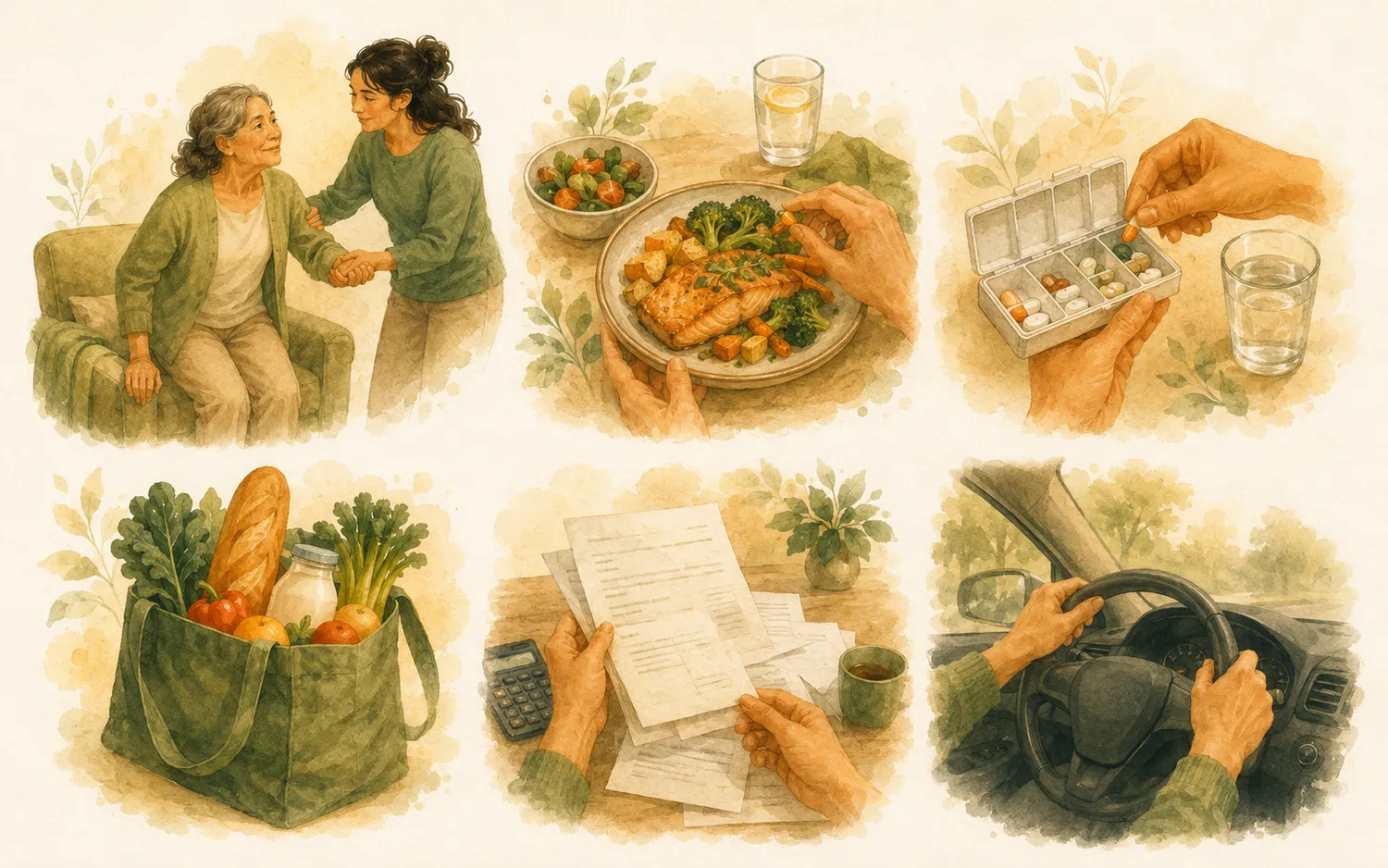
Part of the reason caregiving gets underestimated is that families don't always have words for the work.
Health care and long-term care systems usually sort support into two categories: ADLs and IADLs.
ADLs — activities of daily living — are the basic personal-care tasks: bathing, dressing, eating, toileting, getting in and out of a bed or chair, and managing incontinence. AARP and NAC report that 65% of caregivers of adults help with at least one ADL. The most common is helping someone in and out of a bed or chair, reported by 45% of caregivers.
ADLs are often the moment a family realizes the situation has changed. Helping with groceries feels like a favor. Helping with bathing, toileting, dressing, or transfers usually feels like something else. It's physically demanding, emotionally complicated, and hard to talk about — and it raises real safety questions: fall risk, skin breakdown, infection, dignity, privacy, and whether one person can safely manage it alone.
IADLs — instrumental activities of daily living — are the more complex tasks that independent living depends on: shopping, transportation, preparing meals, housework, managing finances, arranging outside services, and giving medicines, pills, or injections. Here the numbers are striking. AARP and NAC report that 99% of caregivers help with at least one IADL, 84% help with three or more, and caregivers help with an average of 4.5 IADLs.
IADLs are where caregiving hides in plain sight. A family member may not count paying bills, driving to appointments, managing groceries, or arranging rides as "care" — but these are often the tasks that decide whether someone can stay safely at home. They're also the easiest to scatter across texts, sticky notes, memory, and one overburdened person.
That's why ADLs and IADLs are useful terms for families, not just clinicians: they make the workload visible. And they point to a sharper question than "Who's helping?" —
Which ADLs and IADLs are we already doing, and who is responsible for each one?
That question tends to surface the truth faster.
The rise of high-intensity caregiving
For many households, caregiving isn't a short-term favor. It lasts years.
In the 2025 AARP/NAC report, the average duration of caregiving for an adult recipient was 5.5 years, and nearly 30% of caregivers had been providing care for five years or more. On average, caregivers spent 27 hours a week providing care; 24% spent more than 40 hours a week — the equivalent of a full-time job.
Twenty-seven hours a week is not occasional support. It's time pulled from work, sleep, exercise, parenting, marriage, friendships, and recovery. Above 40 hours, a caregiver is effectively working a full-time job without any of a job's boundaries: no set shift, no supervisor, no formal handoff, no paid leave, and often no training.
The intensity is also unpredictable. A caregiver might spend three hours on an ordinary day and twelve on a bad one. The workload spikes after hospitalizations, falls, medication changes, new diagnoses, or sudden shifts in cognition — and because families tend to build their systems reactively, the structure usually arrives only after the crisis does.
That pattern is costly. It leads to missed appointments, medication confusion, duplicated effort, sibling conflict, burnout, and avoidable emergency decisions. A structured approach doesn't remove the emotional difficulty of caregiving. It removes some of the chaos around it.
Caregiving is more medical than families expect
Families are often surprised by how quickly caregiving crosses into clinical territory.
AARP and NAC report that 55% of caregivers perform medical or nursing tasks usually handled by health professionals: giving medications, eye drops, or injections; preparing special diets; managing tube feedings and wound care; monitoring blood pressure or blood sugar; managing incontinence; and operating equipment like hospital beds, wheelchairs, oxygen tanks, nebulizers, or suction machines. Only 22% receive any training for this work.
That gap is the problem. Families are routinely expected to absorb medical responsibility through brief discharge instructions, rushed demonstrations, portal messages, and trial and error. The caregiver becomes the person who has to notice whether the swelling is worse, whether the confusion is new, whether the wound looks infected, whether the oxygen line is working, whether a dose was taken twice, or whether someone is simply weaker than yesterday.
The National Academies has described the medical and nursing dimension of caregiving as increasingly complex, particularly as care shifts into the home, where families may manage medications delivered through multiple routes, technical procedures, medical equipment, and complicated regimens. This is the point at which "family help" becomes health-system labor.
The risk isn't that families don't care enough. It's that they care without enough structure, training, documentation, or backup. A family that tracks symptoms, medication changes, provider instructions, equipment, and warning signs isn't being obsessive. It's building a safer environment.
Why coordination becomes a second job

Caregiving isn't only the task in front of you. It's the coordination around it.
The 2025 AARP/NAC report shows how much of modern caregiving is really health-system navigation: 70% of caregivers monitor the care recipient's condition, 64% communicate with providers, and 58% advocate for the person's needs with providers, community services, or government agencies. Among those who coordinate care, only 58% find coordinating with health professionals easy.
In other words, many caregivers are functioning as unpaid care coordinators. They track what the primary care doctor said, what the specialist changed, what the discharge paperwork specified, what the home health nurse noticed, what the pharmacy filled, what insurance denied, what the family agreed to, and what the care recipient actually wants. The National Academies describes family caregivers as advocates and coordinators who have to navigate disconnected systems — providers, community agencies, employers, Medicare, Medicaid, private insurance — and who often become the single communication link among everyone involved.
This is where families tend to break down. Not from a lack of care, but because the whole system is held together by one person's memory. One sibling knows the cardiologist's instructions. Another has the portal login. Someone else paid the last bill. A third heard about a medication change but never told the person filling the pill organizer. The care recipient says one thing at the appointment and another thing at home. The group chat becomes the care plan — until the important message can't be found at the moment it matters.
Coordination needs a shared source of truth. It doesn't have to be elaborate, but it does have to be consistent: one place that holds current medications and prescribers, diagnoses and history, the care team's contact information, appointments and follow-ups, the ADLs and IADLs the person needs help with, the insurance, legal, and financial documents, the warning signs and when to call for help, and who is responsible for what.
Without that, the caregiver is the database — which works right up until that person gets sick, travels, burns out, or simply misses a message.
The financial burden is part of the care plan
Families tend to separate "care" from "money." Caregiving doesn't.
In the 2025 AARP/NAC report, 47% of family caregivers reported at least one negative financial impact from caregiving — stopping their saving, drawing down short- or long-term savings, taking on debt, borrowing from family or friends, paying bills late, struggling to afford basics like food, working more, taking a second job, delaying retirement, or deciding never to retire. A separate AARP out-of-pocket study found that nearly eight in ten caregivers face routine caregiving expenses, with a typical annual total of $7,242 — an average of 26% of income.
These numbers matter because families usually treat caregiving costs as one-off exceptions. A copay here, a home modification there. Gas. Groceries. Equipment. Incontinence supplies. A missed workday. A paid aide for one afternoon. Another refill, another bill. Without tracking, no one realizes how much a single caregiver is quietly subsidizing the entire plan.
Tracking money isn't only about reimbursement. It's about fairness, planning, benefit eligibility, tax documentation, and transparency — and about keeping one person from absorbing the cost in silence until resentment or crisis forces it into the open. The uncomfortable question is usually easier than the answer that surfaces after years of strain:
Which caregiving costs are recurring, which are occasional, and who is paying them?
The emotional labor is real work
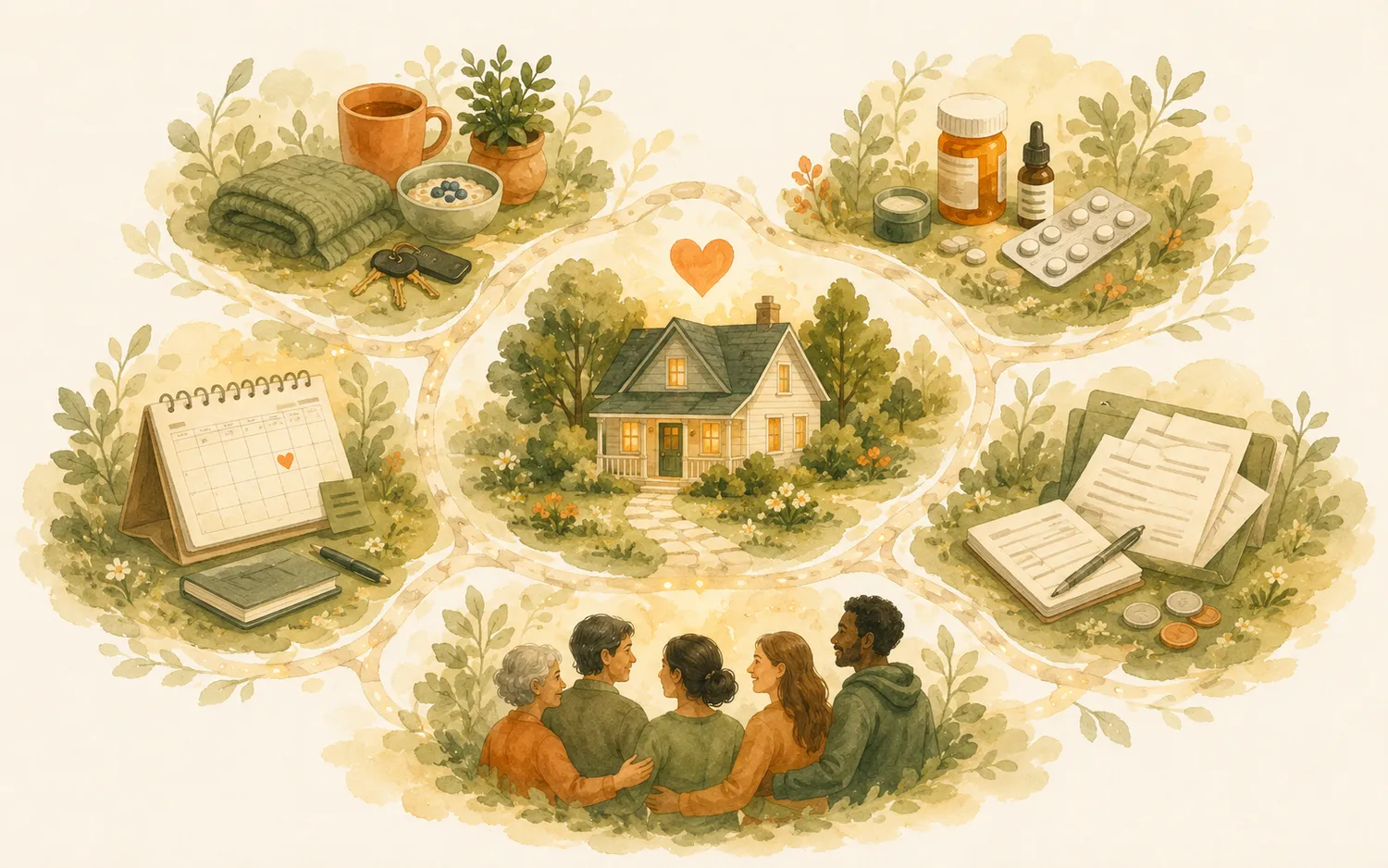
Caregiving is physical and logistical, but it's also emotional: monitoring, decision pressure, anticipatory grief, conflict management, and constant vigilance.
AARP and NAC report that nearly two-thirds of caregivers experience moderate or high emotional stress, 45% experience moderate or high physical strain, 24% feel alone, and 23% say caregiving makes it hard to take care of their own health.
Emotional labor means listening to fear, absorbing frustration, calming agitation, repeating the same explanation, managing siblings' opinions, protecting a parent's dignity, watching for decline, and making decisions with incomplete information. The National Academies describes caregiving as involving not just direct tasks but continual problem-solving, decision-making, communication, and vigilance over the care recipient's well-being.
That vigilance is hard to measure because it usually runs in the background. A caregiver at work is also wondering whether Mom picked up the morning call. A spouse sleeps lightly because a fall could come at 2 a.m. An adult child's stomach drops every time the phone rings. A sibling is quietly tracking whether Dad's confusion is ordinary forgetfulness or something worse. It's all part of the workload — and a system that tracks only tasks misses the cost of simply being the one who's responsible.
What to track before things get chaotic
The best time to organize caregiving is before the family feels desperate. Most wait until a hospitalization, a fall, a diagnosis, a medication error, or a caregiver's breaking point forces it — and then everyone scrambles to reconstruct the situation from scattered texts, paper folders, portal messages, voicemails, and memory.
A better approach is to make the invisible workload visible earlier, across five categories.
1. Daily function. Track which ADLs and IADLs the person can still do independently, which need reminders, which need hands-on help, and which are becoming unsafe — bathing, dressing, toileting, transfers, eating, cooking, shopping, housework, transportation, finances, medications, and arranging outside services. The goal isn't to label someone as incapable. It's to see where support is already needed and where risk is rising.
2. Health and medications. Track current medications, doses, timing, prescribers, pharmacy, allergies, side effects, recent changes, and missed doses, along with diagnoses, symptoms, relevant vital signs, equipment, recent falls, hospitalizations, and clinician instructions. This matters all the more because most caregivers perform medical tasks and only a minority are trained for them.
3. Appointments and decisions. Track appointments — who went, what was discussed, what changed, what needs follow-up — and the open decisions: whether to start home care, whether driving is still safe, whether the home needs modifications, whether legal documents are in place, whether a higher level of care is coming, and who has the authority to decide if the person can't. Caregiving often includes legal and surrogate decision-making, especially where cognition or serious illness is involved.
4. Money and paperwork. Track caregiving expenses, bills, insurance notices, long-term care documents, benefits, legal paperwork, account access, and who is paying for what. Financial strain is common and usually stays hidden until it has already done damage.
5. People and backup. Track who is helping, what each person is responsible for, which outside services are involved, and who can step in when the primary caregiver can't. A plan that runs on one person's memory is fragile.
The family doesn't need perfection. It needs a shared map.
Why caregiving needs structure
The core problem in family caregiving isn't that families fail to care. It's that the care expands faster than the family's system for managing it.
A few errands become transportation management. A few reminders become medication oversight. A few appointments become provider coordination. A few bills become financial administration. A few safety concerns become daily monitoring. A few hard conversations become years of vigilance. By the time anyone calls it "caregiving," one person is often already carrying the calendar, the medication list, the symptom history, the finances, the family updates, the questions for the doctor, the emergency plan — and the guilt.
Structure is simply a way to make that work visible, so the family can answer the questions that actually keep care safe: Who is doing what? What changed this week? Which tasks are becoming unsafe? What did the doctor say? What needs follow-up? What costs are adding up? Who needs relief? And what happens if the main caregiver isn't available?
Those aren't administrative clutter. They're the infrastructure of safer care — and none of it should depend on the most exhausted person in the family remembering everything.
Conclusion: make the work visible before a crisis does
Family caregiving is usually described in soft language: helping out, checking in, pitching in, being there. The numbers tell a more concrete story. Millions of families are providing ongoing care. Nearly all are helping with IADLs. Many are helping with ADLs. More than half are performing medical or nursing tasks. Many are coordinating with providers, managing finances, absorbing disruptions at work, and carrying real emotional strain.
Naming this doesn't make caregiving colder or more clinical. It makes the work legitimate. Families can't share what they haven't named, plan around what they haven't tracked, or support a caregiver while everyone pretends the role is smaller than it is.
Caregiving needs structure because love is not a filing system, a medication list, a shift schedule, a discharge plan, a bill tracker, or a backup plan. The care may be personal. The workload still needs a system.
Free: the aging-parent check-in checklist
The exact questions to ask every time — remote and in-person — as a clean one-page PDF you can print or share with the whole family.
Keep reading
Loneliness in Older Adults: The Evidence, and What Families Can Do
Health risks of loneliness and social isolation in older adults, plus practical, evidence-informed steps families can take.
Care Coordination for Aging Parents: What the Research Shows
Caring for an aging parent is really a coordination problem. What research shows about shared goals, shared knowledge, and safer handoffs in care.
Caregiver Stress and Burnout: What the Research Actually Shows
A calm, evidence-based look at caregiver stress, burnout, and burden — why the scary mortality claims are incomplete, who's most at risk, and what helps.